















One Bill. One Question.
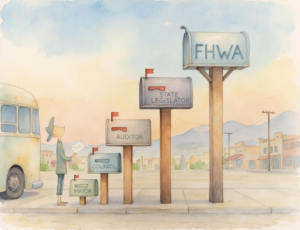
Hosby Harrinknuckle had a bill. The bill had a line. The line said Drainage Assessment — forty-seven dollars and nine cents. Hosby had one question: who was charging him for the rain?
He assumed it would be simple. This was his first mistake.
He called the city. Not us, said the man. Try the county. He tried the county. Try the assessor. He tried the assessor. Try Jim.
Nobody knew who Jim was.
On day four he found Babs. Babs had worked at the county for nineteen years. Babs knew every district, every zone, every line. Babs had built the whole map — one Hosby at a time.
Zone Four, said Babs. Colorado Springs Utilities. Forty-seven eighteen. You're welcome.
Four days. Nine calls. One spaghetti map. One Babs.
The Door Hosby Was Actually Looking For
Hosby's story is about jurisdiction confusion — who governs what in a county where the city, the county, the school district, and several special districts all overlap in ways nobody published a map for.
But there is a second door in this story. The one residents are supposed to use when they want public records. The one with the legal right attached to it.
coloradosprings.gov/CORA.
The Colorado Open Records Act gives every resident the right to inspect the city's public records. The CORA page is where that right is exercised. And when we audited its source code, we found that the door has problems.
From the live HTML source. Verifiable in any browser. Estimated total fix time: three hours of developer time.
| Finding | WCAG | Impact | Fix time |
|---|---|---|---|
| Critical All accordion buttons say aria-expanded="true" when closed. Every section announces as already open to a screen reader. |
4.1.2 | Screen reader users cannot trust the state of any accordion on the page — the primary content mechanism. | 1–2 hrs |
| Critical Six GovOutreach CORA request links open new tabs with no warning. These are the primary action links — the CORA forms themselves. |
2.4.4 | Screen reader users lose their place in the page when a new tab opens without announcement. The forms to request public records are the barrier. | 15 min |
| Critical Weather widget sun icon not aria-hidden. Font Awesome class name read aloud by screen readers. |
1.1.1 | Decorative icon announced as text noise before page content. | 10 min |
| Critical Mobile menu button has no aria-expanded. State never communicated when menu opens or closes. |
4.1.2 | Screen reader users cannot determine whether the navigation menu is open or closed. | 30 min |
| Critical Hero background image loaded as CSS — cannot carry alt text. No accessible description or role="presentation". |
1.1.1 | Background image status unresolved for assistive technology — decorative or informational, neither is communicated. | 5 min |
The full formal findings notice — with exact failing code, exact fixed code, and all seven secondary warnings — is available as a PDF and Word document below.
To be accurate: the city's CORA page has good bones. The skip link works, landmarks are correct, the fees table has a caption, search form labels are properly associated, and social media icons have accessible text. This is a partially-compliant page with specific, fixable failures — not a site built without any accessibility consideration. The failures are the story. The bones are the foundation.
Babs Did Not Sign Up to Be the Map
Babs answered Hosby's question in about forty-five seconds. Zone Four. Colorado Springs Utilities. Forty-seven eighteen. You're welcome.
She had that answer because she had heard the question — in forty-seven different forms — for nineteen years. She had assembled the map herself, from the gaps in the system, one confused caller at a time.
She signed up for something harder than that. Something that needed nineteen years. Not routing Hosby through his drainage-based fears.
The officials who answer the phone, manage the meetings, and field the questions that a clear public-facing system would make unnecessary — they are not the problem. The gap is the problem. And gaps have fixes.
The city jurisdiction checker prototype exists. The county assessor prototype exists. Both are linked above and in the companion guide. Neither required a procurement process. Neither required a committee. One page. Plain language. The right door, the first time.
The question is whether the city and county are willing to look at what's been built — and compare that to what currently exists for Hosby, and for the Hosbys who don't have four days to spend.
Audit the Site Yourself
Every failure documented in this episode is verifiable in your browser in under ten minutes. You do not need to be a developer. You need a browser and five minutes.
Go to wave.webaim.org. Type coloradosprings.gov/CORA in the URL field. Hit Enter. Count the red error icons. Screenshot the result. That screenshot is evidence.
Send it to us. It joins the public record.
The formal accessibility findings notice — with specific code excerpts, WCAG citations, and fix estimates — is available to download below. It is written to be forwarded directly to the city.
The Actions. Right Now.
Pick one. All of these take under thirty minutes and create a record the city must respond to.
The city's Office of Accessibility and city communications are the right first contacts. Name the specific failures. Include a link to this episode.
The city contracts with GovOutreach to run the CORA request forms linked from this page. Those forms are themselves inaccessible. Ask whether the contract includes any accessibility requirements.
Most Tuesdays at 1 PM. City Hall, 107 N. Nevada Ave. Public comment is open. Three minutes. You need one question on tape — not the answer, just the question.
If you personally encountered an accessibility barrier on a city digital tool, you have the right to file a complaint with the Department of Justice. About thirty minutes. Free. No lawyer required.
Questions Worth Asking
Tap any question to copy it. One question in a recorded meeting creates a public record.
Send Us What You Find
A WAVE screenshot. A timestamp. A response email. A voicemail log. The things you find when you run the audit yourself are the things we cannot see from here.
You are not a passive audience. You are a source. The corridor stays open because people on the ground keep walking it.
"The right door had been there the whole time. Just unlabeled."
The Dais · The Map · Special Edition · Episode Four · El Paso County & City of Colorado Springs · March 2026