
























Okay.
Here is the part where we stop describing the problem and become briefly, stubbornly, almost embarrassingly useful.
Because the whole argument of this project — the whole reason to read agendas and sit in folding chairs and care about who is on the planning commission — is that local government is the level where inputs actually connect to outputs. Slowly. Messily. With subcommittees that will test your faith in the basic concept of organized human effort.
But they connect.
And this particular problem — the movement of children through this corridor, through this city, through these systems — is a local government problem. Which means it is addressable by local government. Which means it is addressable by the people who show up.
"The cure isn't motivation. The cure is a smaller lever. Something so local, so immediate, so completely within reach that the gap between input and output is short enough to actually observe."
So here is what showing up looks like. Specifically. For this. Specifically.
The people on the ground.
Four organizations in or near Colorado Springs doing the work that the subcommittee keeps almost funding. These are not endorsements — they're entry points.
Street Outreach · Direct Services · Survivor Support
Real people. Real work. Real need for real funding that comes from real budget decisions made by real boards. Has received CDBG funding — which means the Community Development Advisory Committee is a direct lever for their capacity. covenantnlove.org
Survivor Housing · Restoration
The kind of work that requires a building and a lease and a line item that someone has to approve. Housing decisions connect directly to county planning and social services funding priorities.
Victim Advocacy · Trafficking-Specific Services · Domestic Violence
Has been doing this long enough to have institutional knowledge that is genuinely irreplaceable. Has trafficking-specific services embedded within their broader advocacy work. One of the organizations that keeps coming back to the meetings. tessacs.org
Regional Anti-Trafficking · Front Range
The corridor. The one in the brochure that isn't in the brochure. Regional work that spans the Front Range and requires sustained local funding and political will to exist. laborchild.org
Three boards. Three meetings. All open to the public.
All making decisions that connect directly to the organizations above and the people they serve.
Board of Health
Oversees public health funding and sets priorities for vulnerable population services across the county. Decisions made here determine what gets funded and what gets filed. The organizations doing trafficking-specific work intersect with public health priorities more than almost any other county department.
- When
- 4th Wednesday · 8:30 AM
- Where
- Citizens Service Center · 1675 W. Garden of the Gods Rd
- Bring
- Nothing required. Just show up.
Community Development Advisory Committee
Oversees Community Development Block Grant money — federal dollars that come to this county and get allocated by a local committee to local organizations. Covenant Love has received this funding. So has TESSA. The committee decides how much, to whom, and under what conditions. This is a direct funding lever for the organizations on this list.
- When
- 3rd Wednesday · 12:30 PM
- Where
- 9 E. Vermijo Ave, Colorado Springs
- Bring
- Nothing required. The meeting is open.
Community Corrections Board
Oversees the alternative sentencing and rehabilitation infrastructure that intersects with trafficking cases more than almost any other county body. The pipeline between this board's decisions and the outcomes for survivors is shorter than people realize.
- When
- 3rd Wednesday · 12:15 PM
- Where
- 17 N. Spruce St
- Bring
- Nothing required.
Fill the room.
Here is the humor, such as it is.
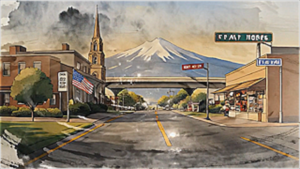
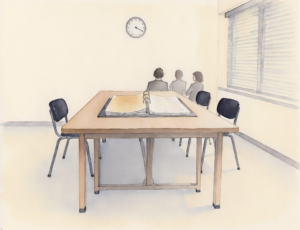
The most powerful thing you can do about a problem that feels this enormous — this institutional, this entrenched, this resistant to everything that should work — is drive to a building on Vermijo Avenue on a Wednesday at 12:30 and sit in a chair.
The chair is free.
The parking is probably fine.
You do not need credentials. You do not need a report. You do not need to be on the subcommittee. You need to be a resident of El Paso County who showed up, which legally and procedurally entitles you to three minutes and a seat in the room where the money gets decided.
The subcommittee will still form. The reports will still get filed. The budget cycle will still come. This is not a story about fixing everything in an afternoon.
But the room will be less empty.
And an empty room is the whole mechanism.
Fill the room.
Part IV — The Exit Ramp. The close: what you carry out of this, what belongs to someone else, and how to know the difference.
Further reading & worksheets.
The series has companion pieces that go deeper on the economics and provide practical worksheets. Optional — but useful if you want to follow the arithmetic or bring this material to a classroom, group, or volunteer orientation.
Part A Everything Costs Something, Including You
The premise the rest of the series rests on: every transaction has a price, and when the commodity is a person, the price is still there — it's just distributed across people who didn't agree to pay it.
Read Part A →Part B What Are They Buying
Who the buyers are, what they're actually purchasing, and why that market exists in a city that looks fine from the outside. The uncomfortable half of the supply-and-demand picture.
Read Part B →Part C What It Costs to Raise You
The overhead of being raised — food, housing, school, medicine, time — and the comparison to what happens when the same child is raised into something else. The numbers are not abstract.
Read Part C →Summary The Full Picture
Parts A, B, and C assembled side-by-side. For readers who want the argument in one piece rather than spread across three.
Read the Summary →Worksheets Jordan's Worksheets
Fillable pages for people who want to track their own show-up, their own follow-through, or who are teaching this material in a classroom, small group, or volunteer orientation.
Open the Worksheets →