






















The Catastrophizing
Three words on the screen.
Safety. Action. Plan.
His heart went first. Not his brain — his heart. That specific thump that happens when your body gets the news before your brain does and your body is not optimistic about it.
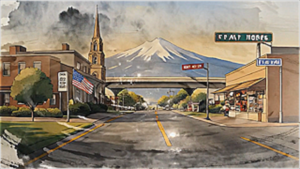
Brannon Meskahashish was in Colorado Springs. He knew the geography of this fact. Five military bases. Planes — there are always planes, the kind that break the sound barrier while you're eating cereal, which he had genuinely accepted as a completely normal breakfast experience. And then there is the mountain. An actual mountain. With blast doors. That the military hollowed out on purpose, because someone looked at Cheyenne Mountain and said: yes. That. We need rooms inside that.
Safety. Action. Plan. Coming from a man named Ambrocius Bodacious Bocephus, with no additional context, as a link in a text message.
His palms went next. His leg started bouncing. His brain did what his brain does — a fast, clinical, efficient spiral through every infrastructure scenario, every reason a government document with those three words might arrive unannounced on a Tuesday evening. The spiral was organized. Practiced. It had categories. He stood up. Sat back down. Stood up again.
He read the full title.
Silence. The specific silence of ten seconds of emergency infrastructure collapsing into a traffic study.
He thought about the planes. He thought about the mountain. He thought, briefly, about whether data existed on military aircraft versus pedestrian incidents over Colorado Springs, because that seemed like something someone should track and he was absolutely going to look it up later.
But that was not what this was.
This was about people. Looking at their phones. Rear-ending other people. Because a light turned from green to red slightly faster than a distracted human brain could process it on a sunny Tuesday afternoon.
Brannon and ABB
Say them both out loud. The episode will wait.
Brannon Meskahashish. Came from New York. Did a stint in the military — the paperwork kind, not the planes kind, which explains approximately nothing about the NORAD catastrophizing but does explain the institutional instinct that says: if something exists in a document, it can be understood, and if it can be understood, it can probably be fixed. He moved to Colorado because he wanted space. Quiet. Landscape that stays landscape. Found Colorado Springs. Had some thoughts about that. Brought Cheetos to a county hearing once and accidentally moved a public record. Has been paying attention ever since.
Ambrocius Bodacious Bocephus. ABB. A man who finds things. Not looks for things — finds them. The way you find a twenty in a coat you haven't worn since winter. Without trying. Without expecting it. He just reached into the pocket of an unremarkable evening and pulled out a $280,000 federally funded traffic safety plan that most residents of Colorado Springs didn't know existed.
He sent the link to Brannon without context, because ABB has a name that arrived with full confidence attached, and that confidence extends to his texting habits.
Brannon catastrophized for ten seconds. Landed on rear-end crashes. Texted back one word.
This is the story of what happened when they went to get it.
The Plan
In 2024, the City of Colorado Springs applied for and received a $280,000 federal grant through the Safe Streets for All program — part of the Infrastructure Investment and Jobs Act — specifically to develop a citywide plan for reducing traffic deaths and serious injuries.
The plan took two years. Crash data analysis. Policy review. Design standard assessment. Stakeholder engagement with over 40 partnering agencies. Public outreach at a farmers market in southeast Colorado Springs. At a library on Sand Creek. At a community meeting in June. It was completed in December 2025. Plan adoption is targeted for May 2026.
Whatever gets adopted will shape how transportation safety money gets spent in Colorado Springs for years. Which roads get maintained. Which signals get retimed. Which corridors get safer. Which ones don't.
Most residents of Colorado Springs do not know it exists.
Not because they don't care. Because nobody told them. No notification. No mailer. No email to residents. No push alert. A page on the city website. A comment period that opened in late March 2026 and closed April 2nd.
ABB found it because the universe placed it in front of him on a Tuesday evening. Most people aren't that lucky.
The Transportation Safety Action Plan sets the framework for how Colorado Springs reduces traffic deaths and serious injuries — which corridors get priority investment, how signals get timed, what design standards apply to new construction, and where the federal safety dollars go for years after adoption.
A plan can say the right things and still spend the money on the wrong things. That's what Episode Six is about. The data is in the Math tab.
The PDF
ABB found the draft Safety Action Plan linked from the city's page. He clicked the link. The PDF didn't load. He tried again. Refreshed. Waited. Tried a different browser. Sent the link to Brannon Meskahashish. Brannon tried. Same result.
They wanted to read it. They had things to say about it. Comments to submit. Opinions to form based on actual information rather than the general shape of a document they couldn't open.
They wrote to the project contact. Politely. Explained the situation. Asked if the comment period could be extended. The response came back. Also politely. The comment period would close April 2nd as scheduled.
ABB made a note to come back. Life intervened. There was no notification. No reminder. No email from the city that said: the comment period you asked about closes in three days. Or two. Or tomorrow.
He checked back.
April 3rd.
The PDF loaded perfectly.
Meanwhile: the call-in option for county public meetings — the one that let residents who couldn't make a 9am Tuesday hearing participate remotely — was discontinued on January 13th, 2026. The stated reason was technical challenges and low participation. The effect was that residents who work, have disabilities, live on military rotation schedules, or simply cannot arrange their lives around Tuesday mornings lost an option. ABB is one of those residents.
He called Brannon.
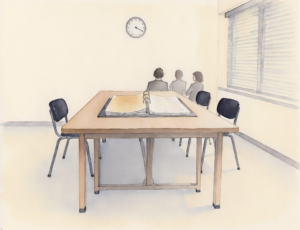
The Room
Brannon Meskahashish found a seat near the back. He had his notes — three pages, though he knew from experience he wasn't getting through them. He had the ADA audit printed out. He had the dashboard data. He had the crash search tool on his phone in case anyone wanted to see it, which in his experience nobody ever asked, but you bring it anyway because you did the work and the work is real.
He reached into his bag. Pulled out the Cheetos. Not dramatically — the way you pull out a granola bar at a long meeting. He counted the names ahead of his on the sign-in sheet. Did the math. He had time.
He opened the bag.
Two heads turned at the crinkle. Brannon did not look up. He reached in. Then stopped. Looked at his fingers. Reached back into his bag.
Pulled out the chopsticks.
One pair for himself. He looked at the commissioners on the dais. Five of them. He looked at his bag. Did the quiet internal arithmetic of a man deciding something. Reached back in. Four more pairs.
He carried all five sets of chopsticks, the Cheetos, his three pages of notes, and the ADA audit to the podium when his name was called like this was a completely normal quantity of things to bring to a public hearing. For Brannon Meskahashish, it was.
He set the notes down. Then the audit. Then the Cheetos. Then — carefully, without explanation — one set of chopsticks in front of the bag, and four more in a neat row facing the dais. One per commissioner.
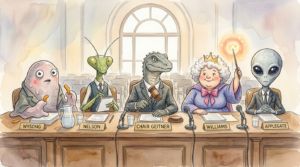
Commissioner Geitner looked at the chopsticks. Then at Brannon. Then back at the chopsticks. The rules of procedure did not cover this. She had the rules memorized. She was certain. Commissioner Nelson was already writing something down — possibly "chopsticks," possibly something completely unrelated, both equally likely. Commissioner Williams looked at her set and something moved across her face that she had the composure to contain but not quite extinguish. She had seen a lot of Tuesday mornings. This was a specific kind. Commissioner Applegate picked his up, held them, set them back down. Parallel. Precise. Said nothing.
Commissioner Wysong looked at the Cheetos. Looked at the chopsticks. Looked at the Cheetos again. Picked up a Cheeto with his hand. No chopsticks. Just picked one up and ate it. Looked at Brannon. Picked up another one.
Brannon watched this happen. Said nothing. Turned back to his notes.
He paused.
All three names. In an El Paso County hearing transcript. Forever.
"He can't be here. The call-in was discontinued in January. He found your Safety Action Plan by accident. He tried to read the PDF. It didn't load. The comment window closed before he could submit anything. There was no notification."
He looked up from his notes. "He's not upset. He's practical. We both are."
He reached into the bag. Put a Cheeto in his mouth with the chopsticks. Chewed. Swallowed.
"We built you something. A dashboard. A crash search tool. An accessibility audit of your own page. The audit took two days. The fixes take 45 minutes. The DOJ deadline is April 24th."
He squared his notes. "We're giving it to you. No invoice."
He looked at the five chopstick sets on the dais. Then at Wysong's fingers.
The hearing continued as hearings do. And then — almost too quiet to catch — there was the sound of a fifth Cheeto. No chopsticks.
What the Numbers Actually Say
Brannon and ABB went and got the data themselves — from the same ArcGIS source the city used. They built a dashboard from it. Made it accessible. Put it online. Free.
Here is what 64,434 crashes tell you.
Colorado Springs is not uniquely dangerous. It actually crashes at a below-average rate for its population size. That matters, because it means the problem is solvable without a massive intervention — you're not fighting a structural catastrophe. You're fighting a specific, identifiable failure point.
The pattern isn't a road design problem. It isn't a weather problem. It's a distracted driver hitting hard on a clear road at speed because a yellow light switched three-quarters of a second faster than a human brain can process when that brain is also processing a text message.
Half a Second
Not a bond measure. Not a lane mile. Not a $280,000 federal study to identify what the data already shows. The fix is this:
Extend the yellow light duration by half a second on high-speed arterials. Re-time the signals on the corridors where rear-end crashes cluster. Maintain the road surfaces so that when someone looks up, there's something smooth to brake on instead of a pothole that sends them sideways.
That's it. The fix is boring. The fix is cheap. The fix is already in the Engineering Criteria Manual — the city's own standards document. Nobody had to invent it.
Brannon Meskahashish figured this out at a kitchen table with Ambrocius Bodacious Bocephus and a bag of Cheetos. No chopsticks that time. They were at home.
Colorado Springs already has engineering standards that address signal timing and road surface maintenance. Those standards were written specifically for situations like this. The gap isn't between what's known and what's possible — it's between what the data recommends and where the budget goes. Episode Six is where those numbers live.
The Dashboard, the Audit, and No Invoice
They didn't just show up and complain. They showed up with the solutions already built and offered them to the city for free.
| What they built | What it does | Cost to city |
|---|---|---|
| Crash data dashboard | Interactive, accessible visualization of 64,434 crashes from the same ArcGIS data the city used | $0 |
| Accessible crash search tool | Plain text, keyboard accessible, screen reader compatible — rebuilt because the city's version failed four accessibility standards | $0 |
| ADA audit of city pages | Two days of work. Every failure documented. Every fix named. Every contact listed. DOJ deadline: April 24th. Fix time: 45 minutes. | $0 |
The crash data interface the city published failed four accessibility standards — meaning people using screen readers, keyboard navigation, or other assistive technology couldn't use it. Brannon and ABB rebuilt it. Gave it away. The DOJ compliance deadline for the accessibility failures they documented is April 24th. The fixes take 45 minutes.
Episode Six is where the full data lives. Episode Seven is where Brannon and ABB present the solution formally, on the record, with the full weight of two people who did the work for free and are offering it to a city that spent considerably more figuring out a version of the same thing.
Pick Your Level
The comment period closed April 2nd. The plan adoption isn't until May 2026. The window didn't disappear — it moved. There is still time to be on the record before this plan becomes final.
ABB couldn't make the hearing. Brannon went for him. You can do either — show up, send something, or file something. Any one of these creates a record that didn't exist before.
The comment period closed April 2nd because the PDF didn't load until April 3rd and there was no reminder system. That is a documented sequence of events. Requesting a late comment or extension is reasonable. Ask directly.
El Paso County discontinued the remote call-in option for public meetings on January 13th, 2026. The stated reasons were technical challenges and low participation. Neither is a legal justification for removing remote access from residents who cannot attend in person. Put this on the record.
The Transportation Safety Action Plan is targeted for adoption in May 2026. That means it will come before Colorado Springs City Council. That is a public meeting with public comment. It is the last on-the-record moment before the plan becomes the framework for years of spending decisions.
Colorado Springs City Council meets most Tuesdays at 1 PM — City Administration Building, 30 S. Nevada Ave. The meeting schedule and agendas are posted at coloradosprings.gov/city-council.
The accessibility audit Brannon presented at the hearing found failures on the city's own Transportation Safety Action Plan pages — including the crash search interface, which failed four accessibility standards. The DOJ compliance deadline is April 24th. The fixes take 45 minutes. The audit was given to the county for free. If the fixes haven't happened by April 24th, that is a federal compliance failure.
Want to know what happened with the PDF — why it failed, when the problem was identified, whether anyone flagged it during the comment period? File a CORA request. The records belong to the public. The first two hours of staff time are free. They have three business days to respond.
Questions You Can Ask Tonight
These are questions that, when asked in a recorded public meeting, create an official record. You do not need to know the answer. You need the answer — or the silence — on tape. Pick one.
Tap any question to copy it to your clipboard.
The Rooms Where This Becomes Final
The Transportation Safety Action Plan is a city plan — it goes before Colorado Springs City Council for adoption, not the Board of County Commissioners. These are the rooms where it gets decided, and all of them are open to you.
City Transportation (Traffic Engineering): traffic@coloradosprings.gov · 719-385-7433
Colorado Springs City Council: coloradosprings.gov/city-council · 719-385-1687
ADA Compliance (El Paso County — David Mejia): ADACompliance@elpasoco.com · 719-520-6866
BOCC Clerk: bocc@elpasoco.com · 719-520-7276 · Agendas: agendasuite.org/iip/elpaso
Open Records (Mike Madsen): MichaelMadsen@elpasoco.com · 719-520-6403
DOJ ADA Complaint (digital accessibility): ada.gov/file-a-complaint
Colorado FOIC (CORA disputes): coloradofoic.org
State legislator lookup: leg.colorado.gov/find-my-legislator
Send Us What You Find
A response email. A timestamp. A screenshot before a page changes. A note from the parking lot. If you submit a comment, file a CORA request, or show up to a City Council meeting when the Safety Action Plan is on the agenda — tell us what happened.
If you record something, grab something, or notice something — send it to us.
Brannon and ABB did the work. The data is real. The fix is boring. The window is still open. We'll see you in Episode Six.
"The chopsticks were there so nobody had to get their hands dirty."
Brannon Meskahashish · El Paso County Board of County Commissioners · April 2026
The Dais · The Map · Three Minutes or More · Series Two · Episode Five · Colorado Springs, Colorado · April 2026